
AI paraphrasing vs humanizing: they're not the same thing
Quick take
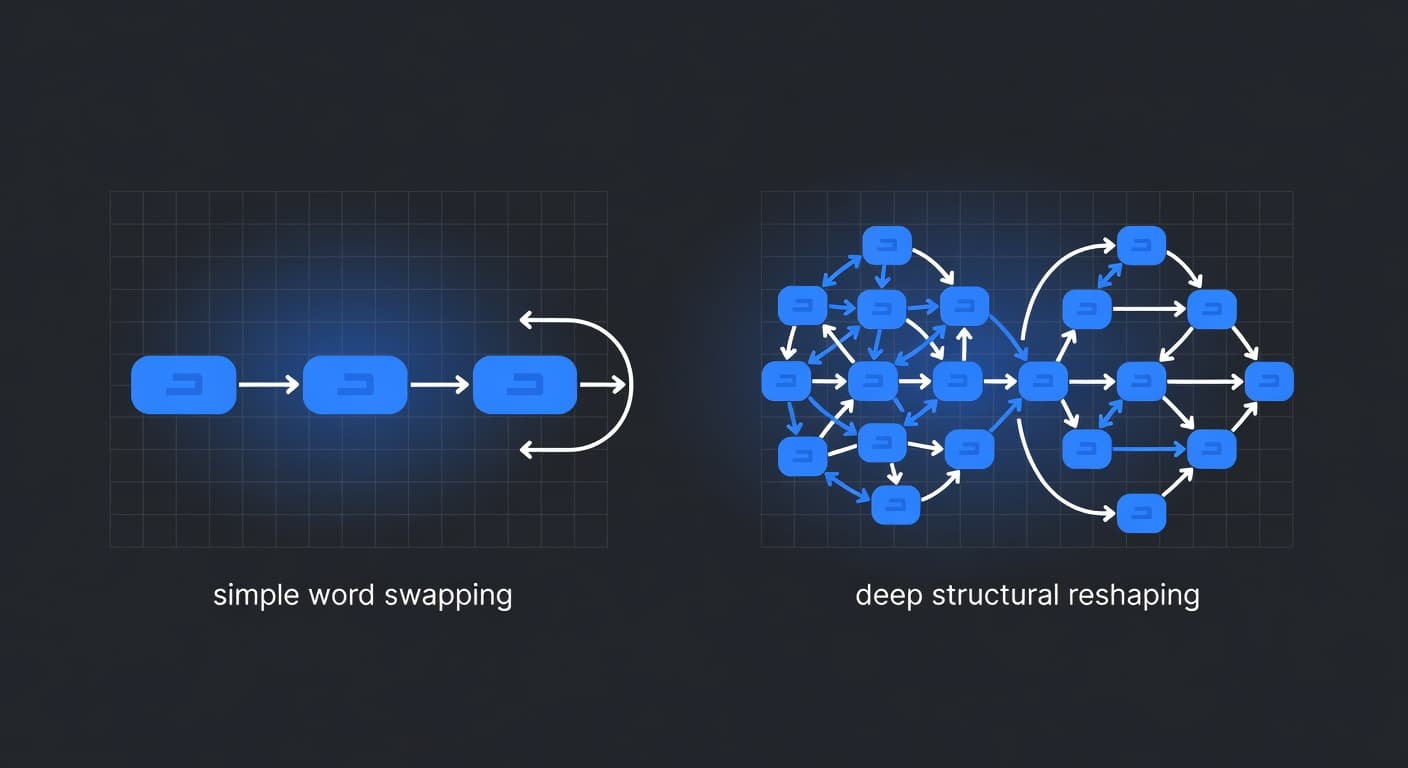
Paraphrasing rewrites text to say the same thing differently. Humanizing rewrites text to break the statistical patterns that AI detectors flag. They overlap, but using a paraphrasing tool when you need humanization is like using a spell checker when you need an editor.
What paraphrasing tools do
Paraphrasing tools replace words with synonyms and rearrange sentence structure. QuillBot, Spinbot, and similar tools have been around since long before ChatGPT. Their purpose: restate existing text in different words while keeping the meaning.
They're built for avoiding plagiarism, not for avoiding AI detection. The difference matters. A paraphrased sentence might use entirely different words but still follow the exact same structural pattern that triggers a detector.
Example. AI wrote: "The implementation of remote work policies has led to significant improvements in employee satisfaction across multiple industries." QuillBot paraphrases it to: "The adoption of work-from-home policies has resulted in notable enhancements in worker satisfaction across various sectors." Different words, identical pattern. GPTZero would flag both.
What humanizing tools do
Humanizing tools target the two metrics that detectors measure: perplexity (word predictability) and burstiness (sentence length variation). Instead of just swapping synonyms, they restructure sentences, vary rhythm, and introduce the kind of irregularity that human writing naturally contains.
A proper humanizer would turn that same sentence into something like: "Remote work made people happier. Not a groundbreaking finding, but the consistency across industries surprised researchers." Same core meaning. Completely different statistical profile.
The restructured version has mixed sentence lengths (5 words, then 11), starts with a short declarative statement, and uses informal vocabulary. That's what detectors can't easily flag.
When to use each
Use a paraphrasing tool when:
- You need to restate someone else's idea in your own words for citation purposes
- You want to avoid exact-match plagiarism in a literature review
- You're summarizing source material and need different phrasing
- AI detection isn't a concern
Use a humanizing tool when:
- You generated text with ChatGPT, Claude, or another LLM and need it to pass detection
- You're publishing content that might be checked by GPTZero, Originality.ai, or Turnitin
- You want AI-assisted text that reads like a real person wrote it
- You're working with voice-trained output that needs a final detection-proof pass
Can paraphrasing tools beat AI detectors?
Sometimes, by accident. If a paraphrasing tool happens to restructure sentences in a way that increases burstiness, the detection score might drop. But it's inconsistent. In our testing, QuillBot reduced GPTZero scores from 95% to around 60-70%. That's still flagged as AI.
Dedicated humanizers like UmanWrite, Undetectable AI, and StealthGPT consistently brought scores below 15%. The gap is substantial because they're solving a different problem. See our humanizer comparison for full test results.
The cost of using the wrong tool
If you run AI text through a paraphraser and assume it's safe, you might get caught. Turnitin's AI detection doesn't care about synonym swaps. It looks at sentence-level probability patterns. A paraphrased AI essay will still flag.
On the other hand, running already-human text through a humanizer is overkill. If you wrote something yourself, a quick detector check is all you need to confirm it won't be misidentified.
The hybrid approach
For best results on longer content, use both tools in sequence. Start with a humanizer to break the AI patterns. Then use a paraphrasing tool on any specific sentences where the meaning drifted too far from your intent. This preserves both the detection resistance and the accuracy of your original message.
Better still: use voice training so the initial output already sounds like you, then humanize for the final pass. That workflow produces the most natural results with the least editing. We cover this in depth in our guide to humanizing AI text.
FAQ
Is QuillBot an AI humanizer?
No. QuillBot is a paraphrasing tool. It rewrites text for clarity and plagiarism avoidance, not for AI detection bypass. It can reduce detection scores slightly, but not reliably enough to depend on.
Do humanizers also paraphrase?
In a sense, yes. Humanizers change wording as part of their process. But the changes are driven by detection metrics, not just synonym replacement. The output is optimized for passing detectors, not just restating the input differently.
Which is cheaper?
Paraphrasing tools are generally cheaper. QuillBot offers a free tier with limited features. Humanizers typically cost $9-15/month. Given that paraphrasers don't reliably bypass detection, the price comparison only matters if detection isn't your concern.
Can I paraphrase humanized text to improve it?
Be careful. Paraphrasing after humanization can reintroduce the predictable patterns the humanizer removed. If the humanized output needs adjustments, do them manually or re-run specific sections through the humanizer.
Sources
- GPTZero - Perplexity and burstiness explained
- QuillBot - Paraphrasing tool
- Originality.ai - Detection accuracy data