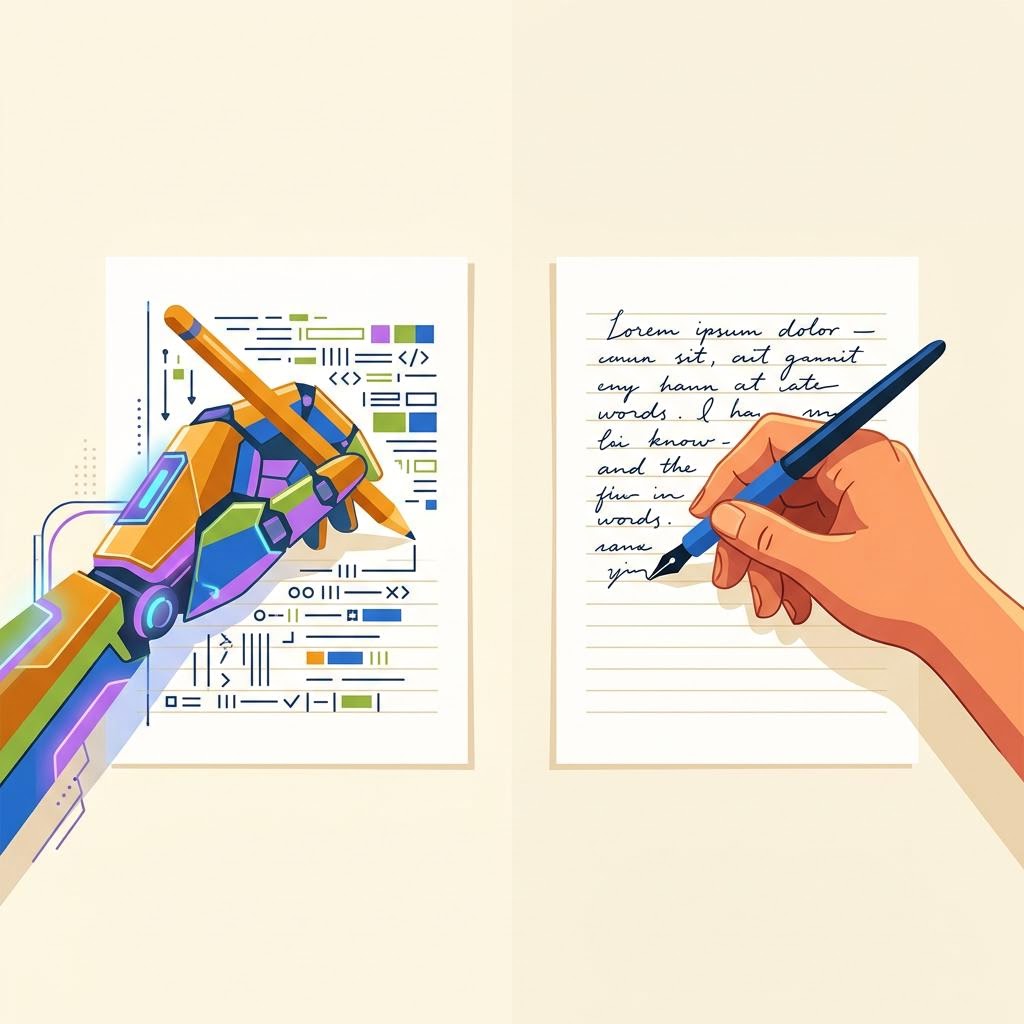
AI detector vs. AI humanizer: what writers should know

Understand how AI detection works, where it can be unreliable, and how to use results as guidance rather than verdicts.
An AI detector scans text for statistical patterns common in machine-generated output (word frequency, predictable transitions, low perplexity variance), while an AI humanizer rewrites flagged passages to introduce natural variation and reduce those signals. As of 2026, both tools are in widespread use by educators, content teams, and compliance departments, yet neither can definitively prove or disprove AI authorship because skilled writers and AI systems increasingly produce indistinguishable output. This article explains how each tool works, their real limitations, and when to use one, the other, or neither in your writing workflow.
How does an AI detector work?
AI detectors analyze text for statistical markers: repetitive phrase patterns, predictable word transitions, low variability in sentence length, and perplexity scores (how "surprised" a language model is by each word). Tools like GPTZero and Originality.ai train on known AI-generated samples and human writing, then flag text that clusters toward the AI end of the spectrum. The core limitation is that they detect patterns, not authorship; a human writing formal prose, following a template, or translating often trips the same signals as GPT-4.
Detection accuracy varies wildly by domain. Academic essays, technical documentation, and marketing copy are easier to flag because AI models train heavily on those genres. Personal emails, creative fiction, and stream-of-consciousness writing are much harder to detect reliably because humans naturally vary these styles more.
What are the main failure modes of AI detectors?
False positives are the larger problem: well-written human text, especially from non-native speakers, people writing in a formal register, or those following strict style guides, routinely scores as AI-written. False negatives also happen; a user who edits AI output with a few manual passes, or who prompts GPT with very specific constraints, often produces text detectors miss entirely.
- Formal, repetitive domains (legal language, technical specs, academic abstracts) trigger false positives in humans.
- Paraphrasing tools and grammar checkers can make AI text less detectable without changing its core authorship.
- Detectors trained on 2023 or earlier models may not catch newer architectures or fine-tuned variants effectively.
- Multilingual writing and code blocks often confuse threshold-based detection systems.
How does an AI humanizer work?
A humanizer takes text flagged by a detector (or proactively applied) and rewrites it to increase stylistic variation, reduce detectable patterns, and add natural phrasing quirks. The goal is to break up the statistical uniformity that detectors key on: vary sentence length, swap common phrases for synonyms, introduce occasional hedges or contractions, and adjust word order in ways humans naturally do. UmanWrite's humanizer learns your personal voice from writing samples, so rewrites sound like you, not a generic template.
Quality humanization preserves meaning and actually improves readability in many cases. Poor humanization introduces typos, awkward phrasing, or changes the intent of the original sentence. The difference between a one-off rewrite and a voice-aware system is significant: generic humanizers make text sound 'human' in a vague way, while voice-trained systems make it sound like *your* human.
When should you use a detector vs. a humanizer?
Use a detector as a diagnostic tool to identify text that might raise red flags with your audience or stakeholders, not as a verdict on authenticity. If you wrote something from scratch and a detector flags it, that's useful signal to review your phrasing for unintentional repetitiveness, but it's not proof of misconduct. Use a humanizer only on content you've already written, edited, and vetted for quality; never rely on it to make poor AI output acceptable.
| Scenario | Detector role | Humanizer role |
|---|---|---|
| You used AI as a first draft, now editing manually | Run detector on final draft to catch any residual patterns you missed | Use on sections that still score high, after your own edits are done |
| You wrote something original, client flagged it as AI | Run detector to show it scores low or to diagnose false positive | Not needed; defender your writing, don't disguise it |
| Content team wants to ensure consistency before publishing | Scan for anomalies that might indicate cut-and-paste or templated sections | Use to smooth out any awkward rewrites before final review |
| Student submitted work flagged by plagiarism system | Re-check with detector to confirm false positive before accusing them | Not applicable; the issue is institutional process, not the tool |
Why humanizers and detectors are locked in an arms race
As humanizers get better at hiding AI patterns, detectors adapt to catch more subtle signals (like unusual word-sense ambiguity or syntactic markers). This cycle means no tool is permanently reliable. A humanizer effective in early 2026 may be less so by late 2026 as detectors evolve.
The practical takeaway: treat both tools as temporary solutions, not permanent fixes. If your content strategy depends on hiding AI use, you've already lost. If your strategy is transparency (using AI where it adds value, then editing for voice and accuracy), detection and humanization become less central to your workflow.
Can you use both tools together?
Yes, but in the right order: write or generate your content, detect what might be flagged, humanize only the sections that scored high, then manually review everything for meaning and voice. Never humanize first and detect later; you'll get false confidence that the text is undetectable, which it may not be.
- Write your content (human, AI-assisted, or fully generated).
- Run a detector scan to see which sections carry AI-like patterns.
- Manually edit high-scoring sections for clarity and voice (this step matters more than any tool).
- If patterns remain after editing, run a humanizer on those specific passages.
- Re-scan with the detector to confirm improvement and catch any new issues introduced by rewriting.
- Do a final read for meaning, tone, and consistency before publishing or submitting.
What should you actually care about in 2026?
Focus on voice consistency and editorial quality, not AI detection compliance. A well-edited piece that sounds like you is far less likely to be flagged than an unedited AI output, and even if it is, good editorial judgment and voice training matter more than any detector or humanizer.
Most organizations in 2026 understand that AI flagging is a signal to review, not proof of wrongdoing. Schools and publishers are moving away from blanket AI bans and toward frameworks that distinguish between inappropriate use (submitting AI work as your own) and appropriate use (using AI as a research or drafting tool, then editing heavily). Your energy is better spent on developing a consistent, authentic voice and explaining your process than on gaming detection systems.
If you're building content at scale or managing a team, UmanWrite's voice profiles let you apply your brand or personal voice to all outputs consistently. This approach solves the real problem: making your content recognizable and trustworthy, not hiding how it was made. For a deeper look at voice customization and humanization together, explore UmanWrite's pricing options and see how voice training can replace ad-hoc humanization workflows.
Frequently asked questions
+What is an AI detector?
An AI detector analyzes text for statistical patterns common in machine-generated output, such as repetitive phrases, predictable word transitions, and low sentence-length variation. It assigns a probability score but cannot prove authorship. Detection accuracy varies by domain and writing style.
+Can AI detectors reliably identify AI-written text?
No. Detectors produce high false-positive rates on formal human writing, translations, and templated content, and miss well-edited AI text. They detect patterns, not authorship, and should be treated as a diagnostic signal, not a verdict.
+What does an AI humanizer do?
A humanizer rewrites text to increase stylistic variation and reduce detectable AI patterns by varying sentence structure, vocabulary, and phrasing. Quality humanizers (like those trained on personal voice samples) preserve meaning better than generic rewrite tools.
+Should I use a humanizer if a detector flags my writing?
Only if you've already edited the content manually for quality and voice, and only on sections that still carry obvious patterns. Never use humanization as a substitute for editing. If a detector flags your original writing, investigate why (false positive?) before assuming you need to disguise anything.
+Is using an AI humanizer considered cheating?
It depends on context and transparency. Using a humanizer to hide that you used AI when an audience expects your original work is problematic. Using it to smooth out AI-assisted drafts you've already heavily edited is defensible if you disclose your process. Institutions and publishers increasingly distinguish between use and misuse.
+How often do AI detectors get better?
Continuously. New AI models and humanizers emerge regularly, forcing detectors to evolve. A humanizer effective today may be less so in months. Neither tool offers a permanent solution; they're diagnostic aids, not structural fixes.
+Can I use a detector and humanizer together?
Yes. Detect first to identify high-scoring sections, manually edit those sections for voice and clarity, then humanize only what remains, and re-detect to confirm. Skip the detector-humanizer loop on already-strong writing.
+Does humanization always improve readability?
No. Poor humanization introduces awkward phrasing or unintended meaning shifts. Voice-trained humanizers perform better than generic tools because they adapt variations to your natural style. Always re-read humanized text for accuracy and tone.